
Southold Previous Residents by Era
One Southold house can leave several kinds of evidence, but their dates do not line up neatly. The current assessment record and deed reference provide the modern starting point. The Suffolk County Clerk index usually reaches recorded and imaged land records from 1987 forward. Before that point, older clerk books, microfilm, historic collections, libraries, and the Southold Historical Society become part of the trail. A record of an owner is not proof of every person who lived at the property, so the household evidence needs its own check.
| Source | Years it covers | Where held | What it shows |
|---|---|---|---|
| County Clerk land index | Generally 1987 to present online | Suffolk County Clerk kiosk | Grantor, grantee, document date, liber and page |
| Historic clerk books | Earlier periods, with exact digitization limit unverified | Riverhead counter, historic holdings, microfilm | Earlier instruments and legal descriptions |
| Curtin directory | 1868/69 | Online extract and historical bibliography | Name, occupation, and locality |
| Telephone directories | 1908 to 1914; West Suffolk runs in 1932, 1937/38, and 1940/41 | Mattituck-Laurel Library and NYS Library listings | Subscriber and address context |
| Federal census | 1790 to 1950 released | Library databases | Household details at the census date |
| Sanborn and aerial sources | 1885, 1920, 1928 to 1930, and 1947 forward | Library of Congress and Suffolk GIS | Building footprint and physical change |
Suffolk County Clerk historic documents show why an old address search often needs more than the online land index.
The historic collection is a separate route for material that does not appear in a current property result. Note: A source date narrows the search, but it does not by itself prove a move-in or move-out date.
Preserve a Southold Address Trail
Before looking for past residents, freeze the identifiers from the most recent Southold assessment or BAS result. Keep the situs address, every known tax-map version, the owner name exactly as printed, the owner mailing address, deed book and page, and any parcel notes. A situs address is where the property stands. A mailing address is where tax notices go. Those fields can differ for ordinary reasons, so neither field should be recast as a statement about who was present at the house.
The Southold BAS tax search accepts owner name, property address, tax map, and bill-number searches one field at a time. Its records make a practical current snapshot. The legal description and tax map are often more stable than an old street string. If a parcel was divided or combined, retain both the former and current identifiers before connecting old records.
- Situs address
- The physical location of the parcel or structure.
- Tax-map identifier
- The section, block, and lot key used to connect assessment, map, and land records.
- Legal description
- The deed language that identifies the land, often through lot, map, metes, bounds, or subdivision references.
Southold Previous Residents Deed Chain
For a Southold ownership trail, use the current grantee as the first link. The Suffolk County Clerk public kiosk supports address or tax-map research as well as name and other modes. An index result can supply the grantor, grantee, recording date, document type, and liber/page. The index is a finding aid. Images and certified copies follow separate purchase, mail, counter, or historic-book routes, so verify the current option before relying on a document.
- Record the current owner, tax map, deed reference, and legal description from the BAS or assessment record.
- Find the current owner as grantee in the clerk index and note the seller, document date, legal description, and parcel references.
- Search that seller as an earlier grantee to find the prior purchase, not merely another document with the same surname.
- Compare legal description, lot language, and tax-map lineage at every step before accepting a connection.
- Split an overly broad name search by date or document route because the kiosk displays no more than the first 2,000 results.
- Grantor
- The party transferring an interest in the recorded deed.
- Grantee
- The party receiving that interest. In a purchase deed, that party is commonly the later owner.
- Chain of title
- A sequence of recorded transfers tied together by the same legal land description.
- Liber/page
- A book and page reference used to locate a recorded instrument.
Southold Deeds Before 1987
The online land-record trail generally begins in 1987, not at the beginning of a Southold property. When the next earlier transfer is outside that range, shift to the Riverhead Clerk counter, historic mortgage or deed books, microfilm, or a historical title-chain file. The County Clerk copies service also offers mail and counter routes for documents that need closer review or certification. Current charges should be confirmed with the custodian because the research did not verify a current image or certified-copy price.
A historic land reference still needs the same checks used online. Match the legal description, parcel lineage, parties, and map references. Mortgages, satisfactions, liens, and judgments may add dates and names, but they do not prove a household lived at the address. Historic clerk minutes begin in 1724, which is useful context for Southold research but not a substitute for the correct land instrument.
Suffolk naturalization records offer a separate name-based historic route from 1853 to 1990 when a house-history question becomes a family-history question.
A naturalization hit can suggest a research lead, but it should be verified with the petition or another dated record before it is attached to an address.
Southold House History Files
The Southold Historical Society research room is the strongest documented house-history route after the online deed trail ends. The Society asks researchers to make an appointment, preferably two weeks ahead. Its material includes the locally organized “Houses 2000” structure files, real-estate records, photographs, diaries, letters, cemetery leads, and chains of title arranged by hamlet or village. That local arrangement can bridge a modern street address with an older place name.
Bring the current tax map, legal description, alternate hamlet names, and a short list of the dates already confirmed. The Society also points researchers to the Planning Department’s SPLIA List for undocumented structures. The Southold Free Library’s Whitaker Historical Collection and staff-assisted local-history materials can add photographs, documents, maps, newspapers, and family context. Access depends on the collection and staff rules.
Southold Historical Society archive background describes the local historical material that supports this house-history work.
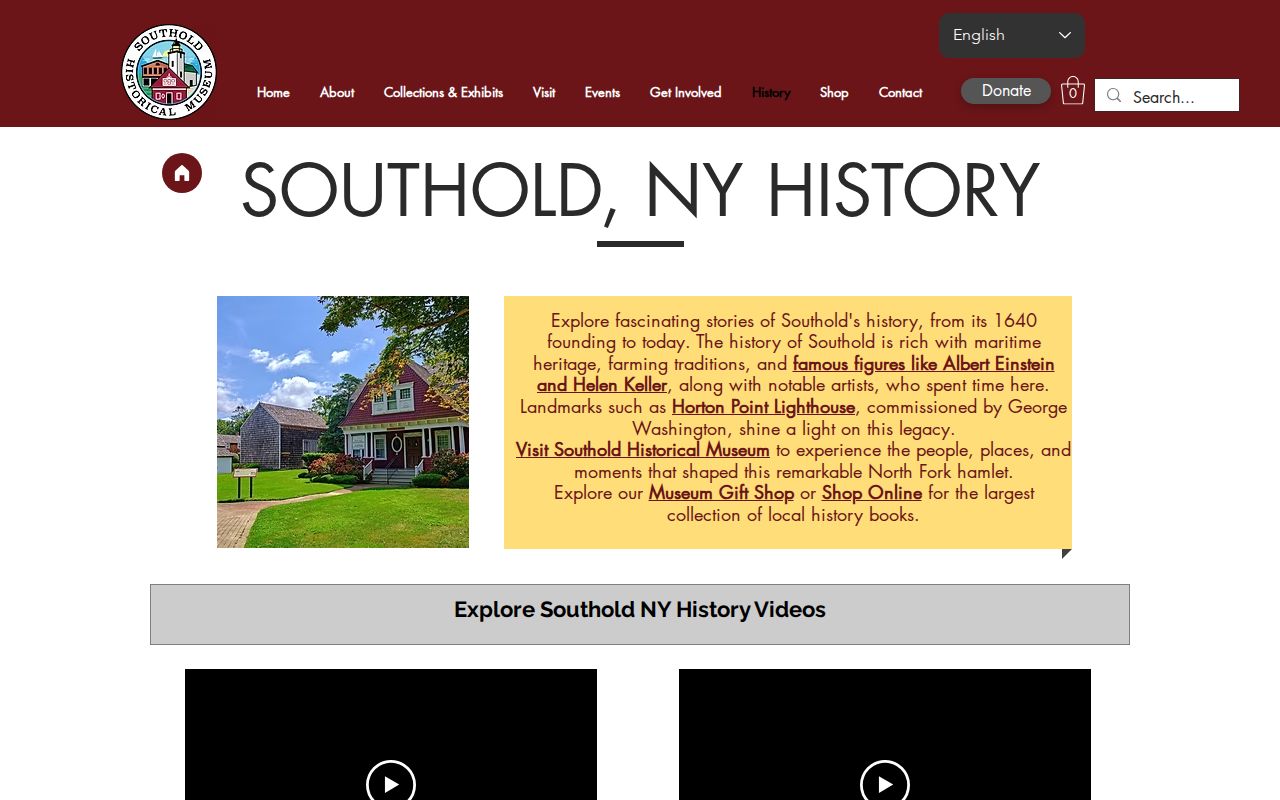
House files can connect structures, maps, and title chains, but a historical reference should not be treated as proof of a current personal address.
Southold Buildings Through Maps
Maps date a physical place, not a person. The Library of Congress holds a January 1885 Sanborn set for Greenport and a September 1920 Mattituck-Southold set. A Sanborn sheet can show a building footprint, material, use, street context, and nearby features at the map date. Suffolk’s cartography resources also provide 1928 to 1930 aerial PDFs and GIS viewer aerials from 1947 forward. Use the maps beside deeds and assessment records to test whether a structure or parcel configuration existed at the time claimed.
The Suffolk Cartography and GIS service describes the county map and aerial access routes. Building and Code Enforcement is the proper fallback for a specific permit or inspection file because no verified public searchable Southold permit-history index was located. A narrow FOIL request should identify the exact address and public file sought. An applicant or project name in a planning file is not proof that the person lived there.
Southold Previous Residents in Directories
Past residents are often found through dated household sources after the property chain is established. Southold’s verified Curtin directory sample dates to 1868/69 and gives a name, occupation, and locality rather than a modern address. Telephone-directory evidence is verified for 1908 to 1914, with West Suffolk telephone books listed for 1932, 1937/38, and 1940/41. Federal census material from 1790 through 1950 is available through library databases. A missing directory entry is not proof of absence. Spelling variants, seasonal residence, women indexed under a spouse, and changing hamlet labels can all create gaps.
- Match an 1868/69 Southold directory clue with the 1870 census and local newspaper or cemetery material.
- Pair a 1908 to 1914 telephone entry with early twentieth-century news, maps, and deed dates.
- Use 1940 to 1950 newspaper references with the released census, keeping the date of each source visible.
- Compare a name, locality, occupation, and neighboring parcels before concluding two same-name entries describe one person.
The historical volumes and library access routes are described in the Southold Directory Book. That collection layer is useful for a one-address search, but a directory entry remains a dated lead rather than a complete household record.
Note: Keep a source-by-source timeline so a telephone subscriber, deed party, and census name are never blended into one undated claim.
Southold Previous Residents at Endpoints
Newspapers, cemetery records, and probate leads can close parts of a past-residents trail. The Long Island Traveler ran as a Southold weekly from 1871 to 1940, while local and state holdings add later Traveler-Watchman material. The Suffolk Times obituary index covers 1910 to 2003. An obituary may provide relatives, a hamlet, or a former address. First Presbyterian Cemetery’s grave locator can join a name to a memorial location, but local sources caution that private cemeteries and lost stones leave real gaps.
The NYPL Salmon Records collection is an unusually early source, documenting Southold-associated marriages and deaths from 1696 to 1815. Probate can connect an owner with heirs, yet the current public estate-index route and fees were not verified in the research. Treat an estate reference as a lead for the appropriate Surrogate’s Court or custodian, not as a complete family record.
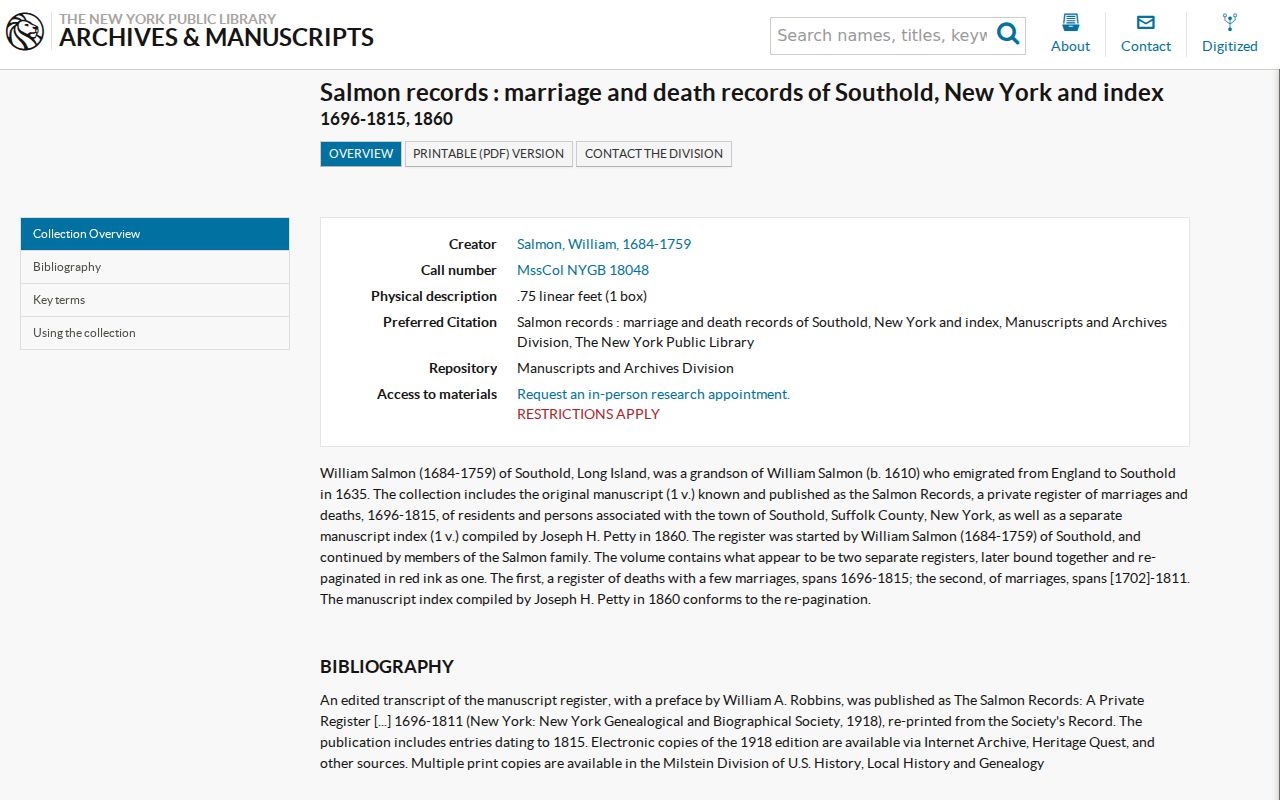
This private register helps with pre-registration Southold family history, while its date range and scope set firm limits on what it can establish.
Southold Address Continuity Checks
Old street wording should be tested, not trusted. The inspected local sources do not identify a Southold-wide renumbering or renaming schedule. Compare historic maps, directory locality, census place, deed legal description, tax-map history, and neighboring parcels when an older string does not match a current address. Fishers Island and the Village of Greenport add another layer because a Southold postal label can point to a different governmental custodian or a different postal geography.