
Southold City Directory Collections
Southold city directory collections are a documented patchwork of local and regional sources. No verified annual municipal directory run was located, and no complete online Polk-style run should be assumed. The collection list below separates what was actually found from what still needs an in-person or archival search. A dated entry can point to a name, occupation, place, telephone, household, or local notice. It cannot by itself establish a present address.
| Collection | Years | Where held | Access |
|---|---|---|---|
| Curtin Long Island directory, Southold extract | 1868/69 | Online extract with Suffolk County Historical Society citation | Free online name, occupation, and place entries |
| Long Island telephone directories | 1908–1914 | Mattituck-Laurel Library scan | Online page images and local history context |
| West Suffolk telephone books | 1932, 1937/38, 1940/41 | New York State Library film listing | Confirm film availability with NYSL |
| Long Island Traveler | 1871–1940; film 1872–1898 | NYSL and local holdings | Microfilm and local newspaper access |
| Traveler-Watchman | 1940–1975 | NYSL and local holdings | Listed local and state holdings |
| Newsday Historical | 1940–1989 | Southold Free Library | In-library database |
| Suffolk Times obituary index | 1910–2003 | Mattituck and Long Island genealogy resource | Decade and surname leads |
| Federal census | 1790–1950 | Southold Free Library databases | HeritageQuest or in-library AncestryPlus |
These dated collections make absence meaningful only with care. Women may appear under a spouse's name, initials can replace a given name, seasonal residence can interrupt a listing, and a hamlet or village label can change. Keep a source note beside every transcription.
Southold Directory Timeline
The record trail reaches well before modern local registration, but its formats change. The timeline is a way to choose the next source after a directory hit or a gap. It does not imply continuous coverage between the listed dates.
- 1696–1815: the NYPL Salmon Records private register preserves Southold-associated marriages and deaths, with a published 1696–1811 version.
- 1868/69: the verified Curtin Southold directory extract records names, occupations, and places.
- 1871–1940: the Long Island Traveler carries Southold weekly news; NYSL film covers 1872–1898.
- 1908–1914: the Long Island telephone-directory scan provides subscriber and address context.
- 1932, 1937/38, 1940/41: West Suffolk telephone books appear in the NYSL film listing.
- 1940–1989: Newsday Historical is available through the Southold Free Library, while the released federal census now extends through 1950.
The date sequence also explains why a family search needs more than one volume. The County Clerk's historic collection has far older materials, while its online land-record imaging baseline is generally 1987. For a nineteenth-century household, newspapers, cemetery cards, family papers, and the historical society may carry the missing link.
Reading a Southold City Directory
The Curtin 1868/69 Southold directory extract is the clearest verified sample of how an old local city directory entry reads. Its visible fields are surname, given name or initials, occupation or civic role, and locality or place. The sample includes Albertson Albert, farmer, Hashamomack; Case J. Wickham, postmaster; Conway Patrick, assistant lighthouse keeper; and other farmers, public figures, and business workers. These details distinguish people with the same surname when no modern street address appears.
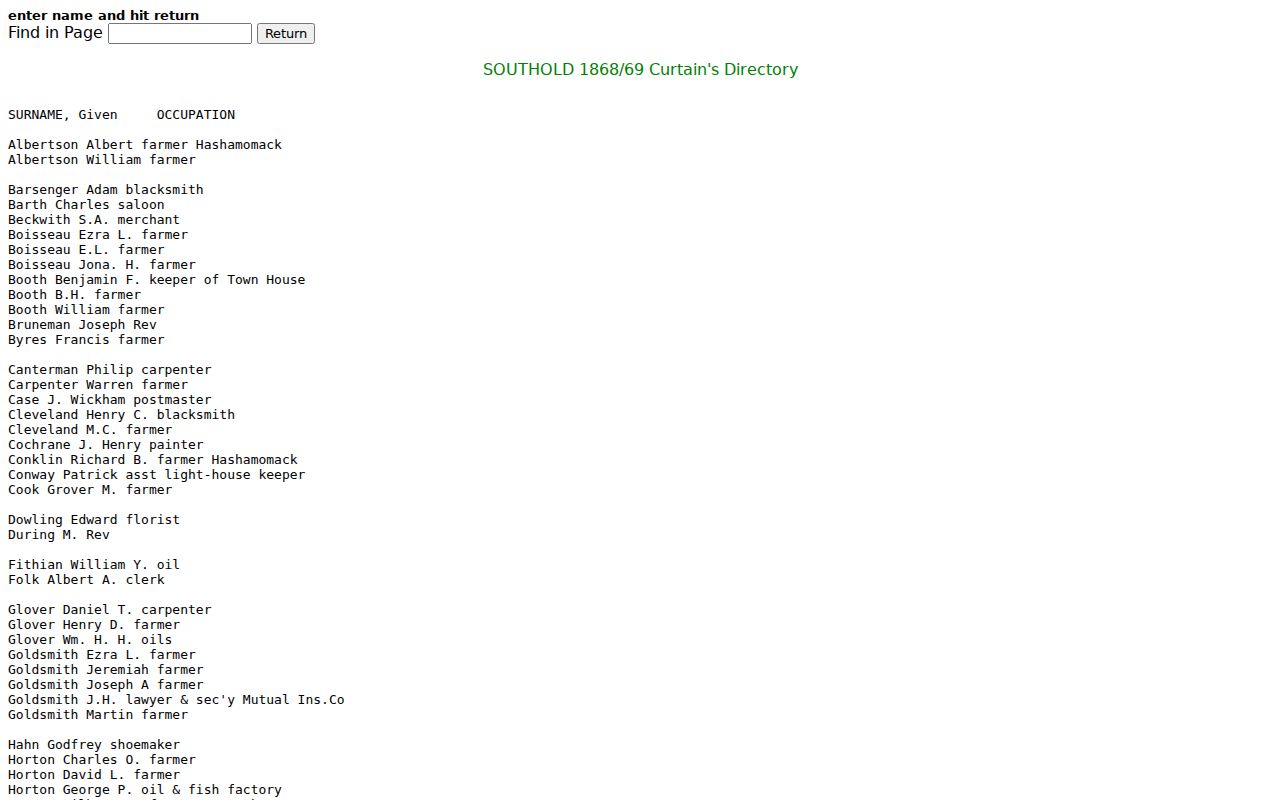
The online extract is a practical discovery tool, but the cited original remains the record to consult when an exact transcription matters. The page title spells the name “Curtain's,” while supporting bibliography generally uses Curtin. Search both spellings.
| Surname and given name | The entry's primary name form, sometimes shortened to initials. |
|---|---|
| Occupation or civic role | A farmer, postmaster, lighthouse role, business, legal, or bank description that helps distinguish a person. |
| Place | A locality such as Hashamomack or Northside, or another identifying place clue. |
| Absent modern fields | The verified extract does not consistently show spouse, house number, owner status, or ZIP. |
| Punctuation and wording | Preserve initials, abbreviations, and original spelling when searching another source. |
Southold Directory Entry Terms
Old directory language can hide the difference between a name lead and a confirmed relationship. Define the record type first, then capture the exact form of the name, place, and occupation. A photograph or transcript of the abbreviation key is useful when a volume provides one.
- Criss-cross directory
- An address-ordered section that can be paired with a name-ordered directory to study an earlier street snapshot.
- Householder index
- A list organized around a household name. No verified complete Southold run of this format was located, so do not assume one exists for a year.
- Abbreviation key
- The volume's explanation of shortened occupations, places, or relationship markers. The Curtin extract's initials and civic labels should be retained as printed.
- Directory absence
- A missing entry that may reflect spelling, a spouse's listing, seasonal residence, an incomplete run, or a place-label change rather than a definite move.
Southold's historical occupations are unusually useful. Farming, fishing, lighthouse service, postal work, and oil or fish-factory activity appear in the 1868/69 sample. Place plus occupation often separates two people more safely than a modern ZIP.
Southold Telephone Directory Snapshots
The Long Island telephone-directory scan covers 1908 through 1914 and includes Jamesport, Laurel, Mattituck, New Suffolk, Cutchogue, Peconic, Greenport, Shelter Island, and Southold. A telephone entry supplies a dated subscriber or address clue. It does not prove a person remained at that location after the directory year. Pair the line with a hamlet name, newspaper notice, census record, or parcel evidence before extending the conclusion.
The New York State Library city-directory holdings list West Suffolk telephone-book films for 1932, 1937/38, and 1940/41. These films are the documented route when the online scan ends. Ask the library to confirm the particular reel and access arrangements before a research trip.
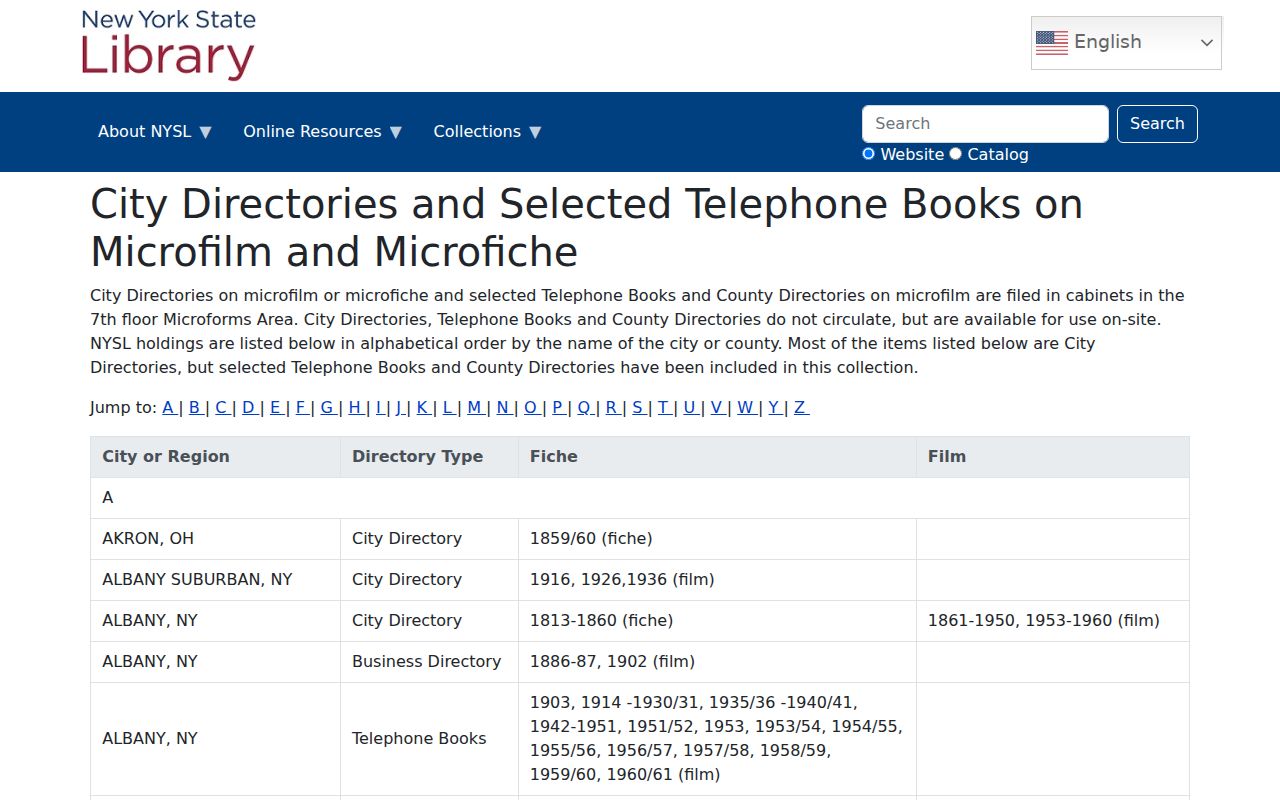
The State Library listing is an index to holdings, not an assurance that each household appears in a given year. It is still a valuable bridge between the early scan and later newspaper or census material.
Southold Directory Library Access
Southold Free Library's genealogy resources provide HeritageQuest and in-library AncestryPlus. The library says AncestryPlus reaches federal census years from 1940 back to 1790 and offers city-directory, newspaper, obituary, military, immigration, and local-history links. Database images can be printed or emailed. Its Whitaker Historical Collection adds local records, documents, and photographs with staff assistance. Computers and scanning are also listed through the library system.
Library access is different from a free name index. In-library databases, staff assistance, scans, and local files can solve a local directory question that an online extract cannot. The public library pages showed conflicting Sunday information during research, so confirm hours before visiting. Mattituck-Laurel Library is another North Fork partner for telephone books, yearbooks, newspapers, postcards, Ancestry, and New York Digital Heritage.
Southold Free Library's newspaper access page describes its historical newspaper resources.
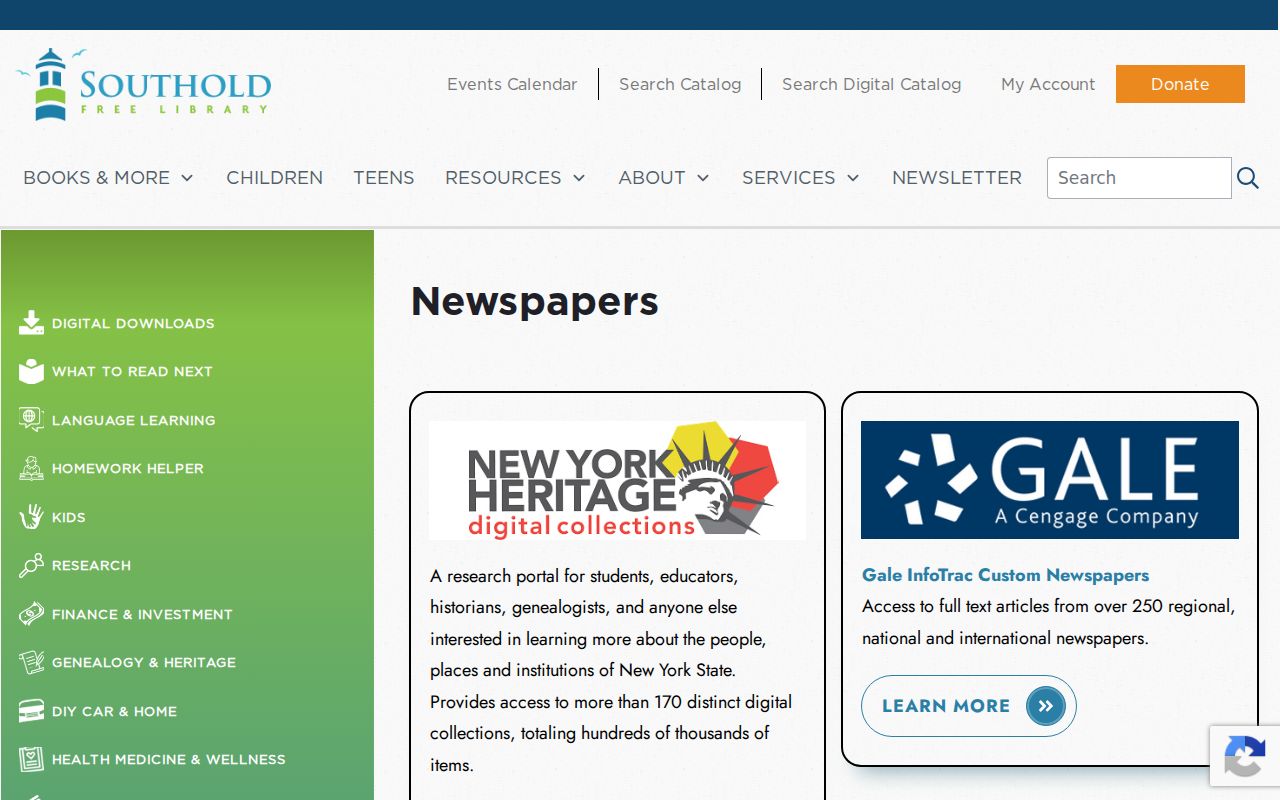
Newspaper and obituary access complements the historical shelf because a notice can connect a date, family name, occupation, and locality that never appeared in a telephone listing.
Note: The library's online and in-person collections have different access terms, so verify the needed database before planning a visit.
Southold Directory House Files
The Southold Historical Society research room is a strong next step when an early directory entry needs to be connected to a structure, family, or hamlet. Its collection runs from 1650 to the present and is strongest after 1784, particularly in the mid-nineteenth through mid-twentieth centuries. Holdings include published genealogies, photographs, diaries, letters, documents, cemetery leads, “Houses 2000” files, and real-estate chains of title organized by hamlet or village.
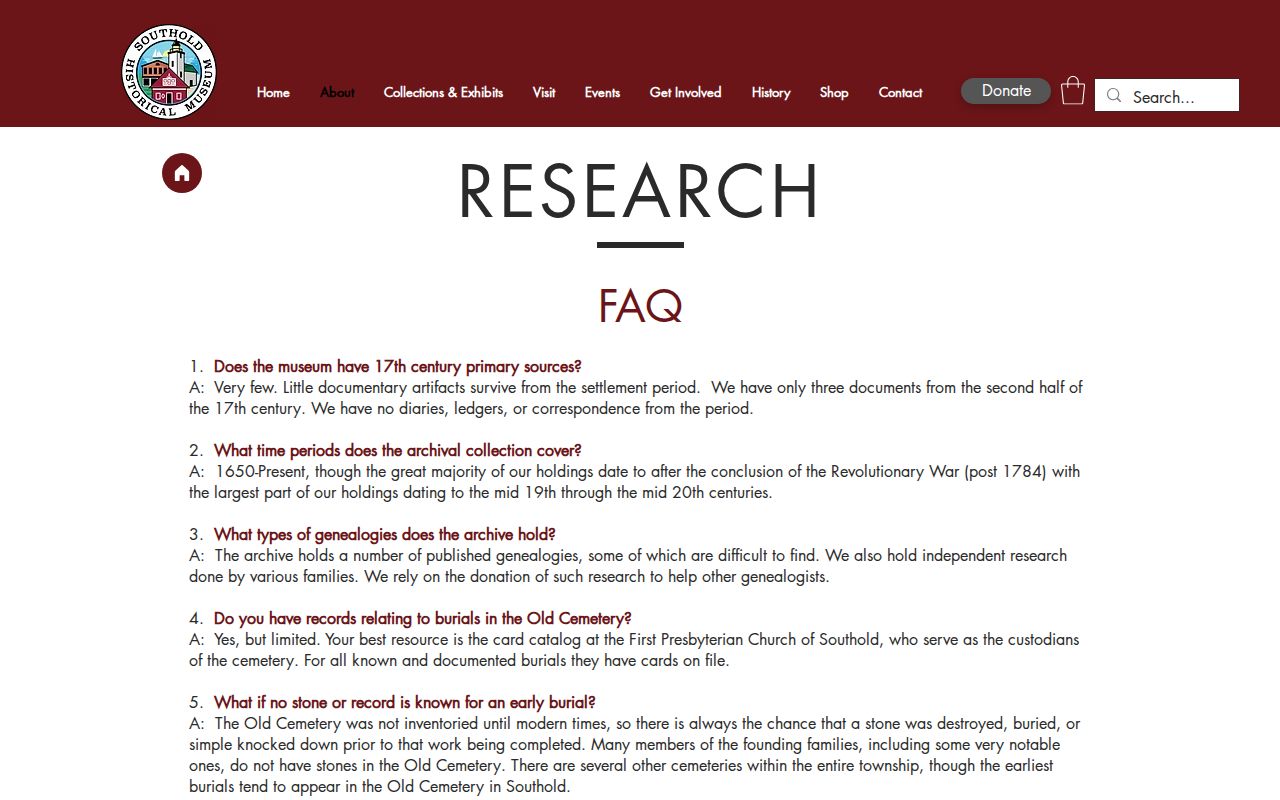
The Society's research room is appointment-only, preferably requested two weeks ahead. Its house files form a useful human-use bridge: an old address can be checked against a title chain, obituary, cemetery lead, and library or yearbook evidence without pretending that one source supplies a complete household history.
For current parcel evidence after a historical lead is established, the Southold Street Directory keeps the BAS, GIS, and deed workflow separate from the historical shelf.
Tracing Southold Directory Families
A household trail becomes stronger when each source answers a date-specific question. Start with an exact name form, occupation, and place in the 1868/69 directory. Search spelling variants in census years, newspapers, obituaries, church material, and cemetery records. For a known address, reverse the process: read the telephone or criss-cross clue, identify the person, then compare deeds and tax maps. A house file can add a title-chain context that neither a directory nor a census supplies alone.
- Record the directory year, name as printed, occupation, locality, and any abbreviation.
- Pair the 1868/69 directory evidence with the 1870 census, retaining the hamlet or place clue.
- Pair a 1908–1914 telephone result with early twentieth-century newspapers and local directories.
- Use Newsday, Traveler, Traveler-Watchman, and the Suffolk Times obituary index to close dated gaps.
- Pair 1940–1950 newspaper material with the released federal census, then test a property lead through recorded deeds.
A name disappearing from a collection can mean a move, death, alternate spelling, seasonal absence, a spouse's listing, or a collection gap. Do not treat it as a conclusion without a second source.
Southold Newspaper Directory Trails
Newspapers act as a companion directory when a volume has no entry or no complete run survives. The New York State Library identifies the Long Island Traveler as a Southold weekly from 1871 through 1940 and lists film from April 18, 1872 through December 30, 1898. Traveler-Watchman holdings are listed for 1940 through 1975. The Library of Congress records Suffolk Times coverage of Southold even after the publication location shifted from Greenport to Mattituck.
Southold Free Library makes Newsday Historical for 1940–1989 available in-library and supplies full text from more than 250 newspapers. The local genealogy resource points to a Suffolk Times obituary index covering 1910–2003 by decade and surname. An obituary, announcement, or notice should be cited for what it says, then compared with census, cemetery, library, or deed material.
Southold Pre-Registration Records
For Southold people before state registration or before an available city directory volume, First Presbyterian Cemetery and the NYPL Salmon Records provide different routes. The cemetery's online grave locator can tie a name, lot, and memorial to a place, though local sources warn that private or family cemeteries and lost stones make it incomplete. The Salmon register is a private record of Southold-associated marriages and deaths from 1696 to 1815. It is a pre-registration lead, not a substitute for every local vital record.
Southold's town history begins with settlement in 1640, and the County Clerk's historic library reports minutes beginning in 1724. That long record trail explains the mix of old books, local archives, cemetery cards, manuscripts, and later directories. It also means a search should retain variant spellings and place labels instead of forcing them into a modern address.
Southold Directory Limits
An old Southold directory is evidence from a particular date and publisher, not a complete census of everyone in town. The verified Curtin extract does not consistently show spouse, house number, owner status, or a modern ZIP. Telephone books record subscribers, not every person in a household. Newspapers and obituaries can omit people, and historical indexes may preserve a spelling variant or a short form. Cite the source, date, place, and exact name form whenever a record is used.
Southold's ten hamlets, the incorporated Village of Greenport, and Fishers Island can further split a search. Greenport records may be held by the village rather than the town, and a place named in an early directory may not match a current postal label. Use historical sources for family history, reunion, estate, and house-history questions. Do not use a directory entry to harass, stalk, or harm anyone.